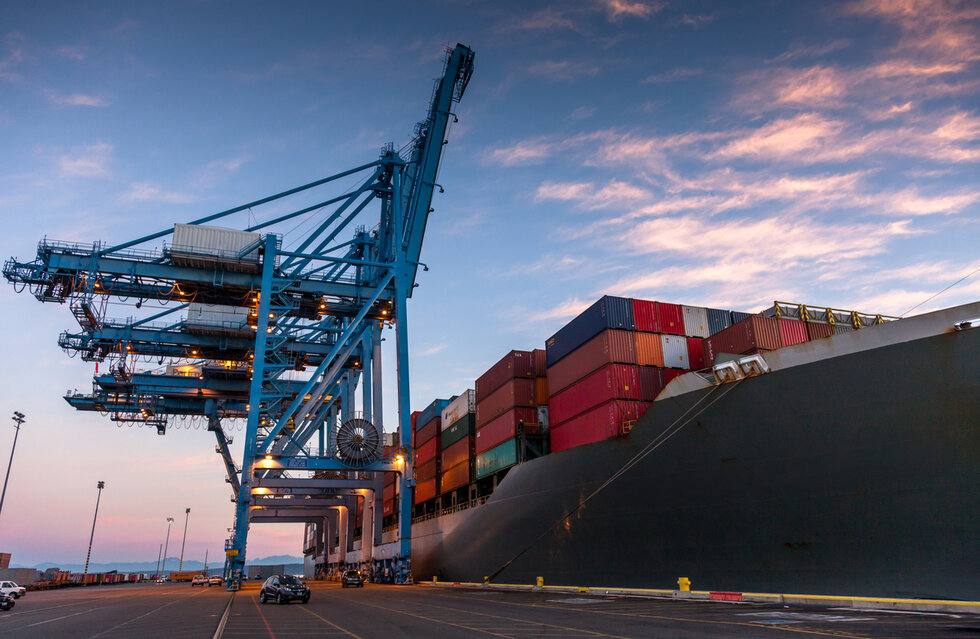
The Gulf is in the middle of the most ambitious logistics infrastructure build-out in its history. Governments across the region have committed an estimated $110 billion in combined logistics investment — reshaping port capacity, activating new multimodal corridors, and creating trade networks that simply did not exist five years ago. For procurement and logistics teams across the GCC, procurement automation is no longer optional — it is the operational backbone of a region building faster than any manual process can manage.
The scale of what is being built is significant. Saudi Arabia’s port investment programme spans $2.67 billion across 18 logistics hubs. Khalifa Port in Abu Dhabi recorded 9.6 million TEUs in the first half of 2025 — a 21% year-on-year increase — and has entered the global top 40 container ports. Oman’s Duqm and Salalah ports are being developed as Indian Ocean gateways connecting Asia, Africa, and Europe. The recently launched Sharjah–Dammam multimodal corridor creates a direct new link between the UAE and Saudi Arabia’s eastern province. And Saudi Arabia Railways has activated a 1,700-kilometre freight route from Dammam’s ports to the northern border, cutting transit times by half.
Each of these developments represents a genuine and durable shift in how the region connects to global trade — and each carries a significant and growing expansion in procurement complexity.
New corridors mean new suppliers — and that is a procurement challenge
Every trade corridor that activates brings with it a new ecosystem of suppliers. New freight agents, logistics sub-contractors, customs brokers, warehousing partners, and compliance specialists — operating across jurisdictions that may not have previously worked together, under regulatory frameworks that are still being aligned.
For port operators, free zones, and logistics companies at the centre of these new flows, the commercial pressure to qualify and onboard new supply relationships quickly is real. A new corridor is only as valuable as the supplier network that enables it to function. And the speed at which that network can be built and managed is increasingly a competitive differentiator — not just an operational consideration.
Most procurement functions in the region are managing this growth with processes that were designed for a smaller, more stable supplier base. Qualification runs through email chains. Compliance documentation lives in spreadsheets. Onboarding a new logistics partner takes weeks — sometimes months — when the market is moving in days.
The gap between the pace of infrastructure development and the pace of procurement capability is where opportunity becomes bottleneck.
What procurement automation looks like for GCC port and logistics operators
Organisations that are keeping pace with the Gulf’s logistics expansion tend to share a set of capabilities that others are still building toward.
They have a clear, repeatable supplier qualification process — one that does not depend on a single team member to execute manually. They maintain centralised visibility across their supplier base in multiple geographies, so they can identify gaps quickly as new corridors create new capability requirements. And they run compliance workflows that adapt to new jurisdictional requirements without rebuilding from scratch each time a new market activates.
None of these are exotic capabilities. But they are surprisingly rare in practice. The investment going into Gulf port and logistics infrastructure is outpacing the investment most organisations have made in the procurement infrastructure needed to leverage it.
The commercial case for moving now
In a stable logistics environment, procurement agility is a nice-to-have. In an environment defined by rapid corridor expansion and growing supplier ecosystem complexity, it is a competitive differentiator.
A port that can qualify and contract new feeder service providers faster than its peers captures more volume. A free zone that can onboard new logistics tenants at pace retains occupancy and attracts investment. A 3PL that can build compliant supplier relationships across a new corridor before its competitors is the one that wins the contract.
The Gulf’s logistics infrastructure build-out is not slowing down. The Khalifa Port bonded rail link to Fujairah is operationalising through 2026. NEOM’s fully automated container terminal is targeting completion the same year. Saudi Arabia’s port privatisation programme continues to unlock new commercial models across both coasts. Each of these milestones will create new supplier ecosystems — and new procurement requirements — for the organisations connected to them.
The organisations building now will lead
For procurement leaders at port operators, free zones, and logistics companies across the Gulf, the question is not whether this investment wave will require a more capable procurement function. It will. The question is whether that function will be ready before the next corridor goes live — or after.
The organisations investing in procurement infrastructure now — supplier onboarding automation, cross-border compliance workflows, real-time visibility across multi-geography supplier bases — are positioning themselves to move at the speed the region’s ambition demands. Those that wait are not preserving optionality. They are falling behind a market that is not pausing.
The Gulf’s trade map is being redrawn. Procurement is how organisations navigate it.
JAGGAER helps port operators, free zones, and logistics companies across the Gulf qualify new suppliers faster, automate compliance workflows, and maintain real-time visibility across complex, multi-country procurement networks. To find out how, speak to our team.