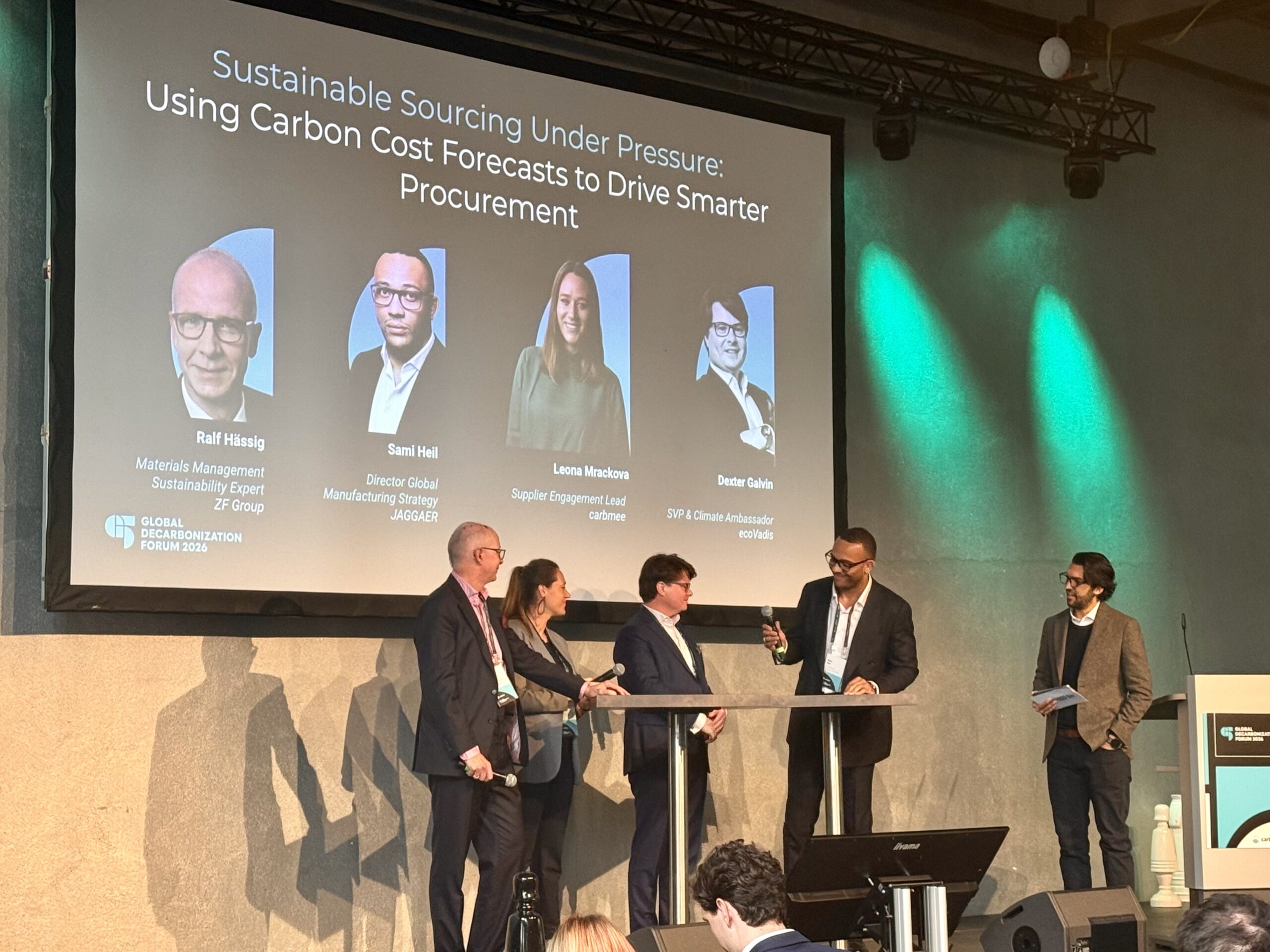
The compliance window has closed. Carbon is now an operational and financial variable — embedded in import decisions, supplier selection, and materials sourcing. Here’s what that means for procurement and supply chain leaders in industry.
The Question That Comes Up in Every Leadership Conversation
Most large industrial companies now have some form of carbon reporting. Sustainability teams produce annual emissions inventories. ESG reports are filed. Scope 1 and 2 are measured, disclosed, and often reduced through energy efficiency programs.
And yet, a persistent question keeps surfacing in boardrooms and procurement departments across Europe: “We have the data. Why aren’t we using it to make better decisions?” This gap — between carbon transparency and carbon action — is the central challenge of industrial decarbonization in 2026. And closing it is no longer just a sustainability imperative. It’s a business imperative.
Why 2026 Is the Turning Point
Three converging pressure points have made 2026 the year when carbon shifts from sustainability reporting to operational priority.
CBAM: Carbon as a Direct Cost Item
The EU Carbon Border Adjustment Mechanism entered its definitive phase on January 1, 2026. For manufacturers importing steel, aluminium, cement, fertilizers, hydrogen, or electricity into the EU, the embedded carbon of those materials is now a direct cost item. Importers must purchase CBAM certificates proportional to embedded carbon — meaning the CO₂ intensity of your supplier base now appears on the P&L.
This is not a future scenario. It is current operational reality.
CSRD: The Data Quality Question
The first wave of CSRD/ESRS reporting — for large public-interest entities — concluded in early 2025. The finding was uncomfortable: companies discovered they lacked auditable supply chain emissions data. Sustainability reports were based on spend-based estimates and industry averages — sufficient for disclosure, insufficient for operational management or external audit.
Wave 2 (all large companies) and Wave 3 (listed SMEs) are next. The data quality problem doesn’t resolve itself.
SBTi: Scope 3 Emissions Become a Customer Requirement
Over 9,000 companies worldwide have set or committed to Science Based Targets. SBTi requires Scope 3 action where those emissions exceed 40% of total emissions — which is almost always the case for manufacturers. The consequence: Scope 3 performance is now embedded in customer RFQs and OEM procurement requirements. Carbon has become a commercial criterion.
The Blind Spot of Decarbonization
Here is the number that reframes the entire problem. According to the CDP Supply Chain Report, supply chain emissions in industry are on average 11.4× higher than own operational emissions (Scope 1 and 2).
This has far-reaching consequences for decarbonization strategy. Energy efficiency programs, power purchase agreements, and factory-level optimization are valuable — but they address less than 20% of a typical industrial footprint. The biggest levers are not inside the factory walls. They sit in procurement and supply chain:
- Which suppliers are selected, and on what criteria?
- Which materials are specified, and from which regions?
- How are tenders and award decisions structured?
- Which make-or-buy decisions are made with a carbon cost lens?
- How are supplier development programs designed and made measurable?
Procurement and supply chain don’t support the decarbonization strategy. For most manufacturers, they are the decarbonization strategy.
Where Siloed Approaches Fail
The classic response to this challenge was to run sustainability or carbon accounting tools in parallel alongside existing procurement systems. The result is a workflow that looks roughly like this:
- The procurement team runs a tender based on cost, quality, and delivery performance
- The sustainability team tracks supplier emissions separately via questionnaire
- Carbon data arrives weeks or months later — after procurement decisions have long been made
- Both teams work with different data statuses and timelines
- Reports are produced, but actual sourcing behavior doesn’t change
The problem is structural, not operational. Transparency without integration produces reports. Integration produces better decisions.
The Value Case: Procurement, Supply Chain, and CFO
For Procurement: Multi-Criteria, Carbon-Intelligent Sourcing Decisions
When carbon data is embedded in procurement execution — not maintained in parallel — it changes what procurement teams can deliver:
- Smarter supplier selection: Evaluate suppliers on price, quality, delivery, and verified CO₂ performance in a single view. Carbon becomes a real evaluation dimension, not a qualitative checkbox.
- Carbon-intelligent tenders: Suppliers provide emissions data as part of their bids — in the procurement workflow, not via separate sustainability questionnaires. Costs and carbon are compared side by side.
- Better make-or-buy and award decisions: Include carbon cost equivalents in make-or-buy analyses and award logic — especially relevant for CBAM-affected materials. Avoid locking in emissions-intensive supplier relationships before regulatory or customer pressure forces a costly switch.
- Credible supplier development: Move from supplier evaluation to supplier enablement. Embed CO₂ reduction targets in supplier contracts, track progress within the procurement platform, and build a sustainability narrative anchored in real sourcing data.
For Supply Chain: Forward-Looking Management Instead of Backward-Looking Reports
Carbon-integrated supply chain planning means:
- Mapping the highest carbon risk concentrations by supplier, material, and region — before they appear as cost surprises or audit findings
- Identifying which supply flows create CBAM exposure or ESRS reporting gaps
- Integrating regulatory sensitivity into supply chain planning — proactively, not reactively when it hits margin or continuity
- Recognizing that resilience and decarbonization are not competing goals: diversifying away from emissions-intensive, geographically concentrated supply chains typically also reduces single-source risks
In industry, critical suppliers cannot be replaced overnight. The strategic response to an emissions-intensive supplier is rarely “replace” — it is “develop together.” Carbon-integrated procurement creates the workflow for shared targets, progress tracking, and accountability.
For the CFO: Risk Management, Margin Protection, Capital Allocation
Decarbonization creates enterprise value only when it is connected to financial decisions.
- Risk management: Quantify and reduce CBAM import cost exposure; improve ESRS/CSRD Scope 3 auditability; model future carbon pricing scenarios for the supplier base.
- Margin protection: Identify carbon cost exposure before it hits the P&L; include carbon equivalents early in sourcing decisions; avoid supplier switches forced by customer-side requirements.
- Capital allocation: Prioritize investments with dual carbon and financial returns; build evidence-based business cases for decarbonization capex; unlock sustainable finance through verifiable EU Taxonomy alignment.
JAGGAER + Carbmee: From Insight to Action
The integration of JAGGAER and carbmee brings together two complementary capabilities:
Carbmee delivers the carbon intelligence: product carbon footprints, CBAM tracking, ESRS Scope 3 data, supplier carbon profiles.
JAGGAER delivers the procurement execution: tenders and sourcing events, supplier management, contract management, and complete source-to-pay processes for industry.
Together, they close the gap that has kept carbon data separate from procurement:
- Carbon in the tender: Embedded as a live criterion alongside cost and quality in every sourcing event
- CBAM compliance: Certificate tracking and embedded carbon calculation flowing directly from procurement data
- Verified supplier data: Supplier carbon profiles collected and verified in the procurement workflow — not via parallel questionnaire processes
- A shared data foundation: Procurement, sustainability, and finance always working from the same numbers
The market doesn’t need another carbon dashboard. It needs carbon embedded in procurement and supply chain execution.
What’s Coming Next: The 2026–2028 Agenda
Four trends will redefine how manufacturers manage decarbonization in their supply chains over the next two years.
Carbon enters commercial negotiations. Leading procurement teams are already asking not just “What is your footprint?” but “What reduction pathway can you commit to?” Carbon performance is moving into supplier contracts, award logic, and long-term agreements. Procurement readiness today creates structural advantage in 12–24 months.
Deeper supplier tier transparency. Today: predominantly Tier 1. Tomorrow: material hotspots, Tier 2/3 transparency, and verified primary data. CBAM already requires traceability to the point of emission. CSDDD and future Scope 3 assurance requirements will push this further. Platform-based data collection will be the differentiating factor.
Carbon integrates into corporate performance management. EFRAG’s ESRS and ISSB’s IFRS S2 are converging on an integrated corporate report. Carbon metrics will sit alongside cost, revenue, and margin in the same performance management infrastructure — with the same data quality and operational traceability as financial KPIs.
Supplier collaboration replaces supplier screening. The market is shifting from “evaluate and rank” to “engage and reduce” — especially in industry, where supplier switching costs are high. Companies that manage joint carbon reduction programs within their procurement platform — not in separate sustainability tools — will move fastest and most credibly.
Three Key Takeaways
- Carbon is a cost, risk, and competitive variable — not a reporting metric. It belongs in procurement and supply chain decisions, not just sustainability reports.
- The biggest decarbonization levers sit in procurement. Supply chain emissions are on average 11.4× higher than operational emissions. Scope 1 and 2 optimization alone doesn’t move the needle.
- Siloed systems report emissions. Integrated ecosystems reduce them. That is the difference JAGGAER and carbmee deliver together.
The next chapter of sustainable industry will not be won by the companies with the most dashboards — but by those who connect carbon insight with procurement action, supply chain decisions, and financial accountability.
Ready to explore what carbon-integrated procurement looks like for your supplier base? Book a 30-minute discovery session with a JAGGAER expert now.